
Under the expert leadership of qualified engineers, rubber technologists, and production specialists, Toughtec has built over three decades of craftsmanship into producing one of India’s finest Rice Dehusking Rubber Rollers.
Recently, our NBR (Nitrile Butadiene Rubber) rollers were tested across Brazil, Peru, Venezuela, Paraguay, Bolivia, Thailand, Nepal, India, and Southeast Asia, consistently outperforming some of the best-known brands from India, China, Vietnam, and Brazil in both performance and efficiency.
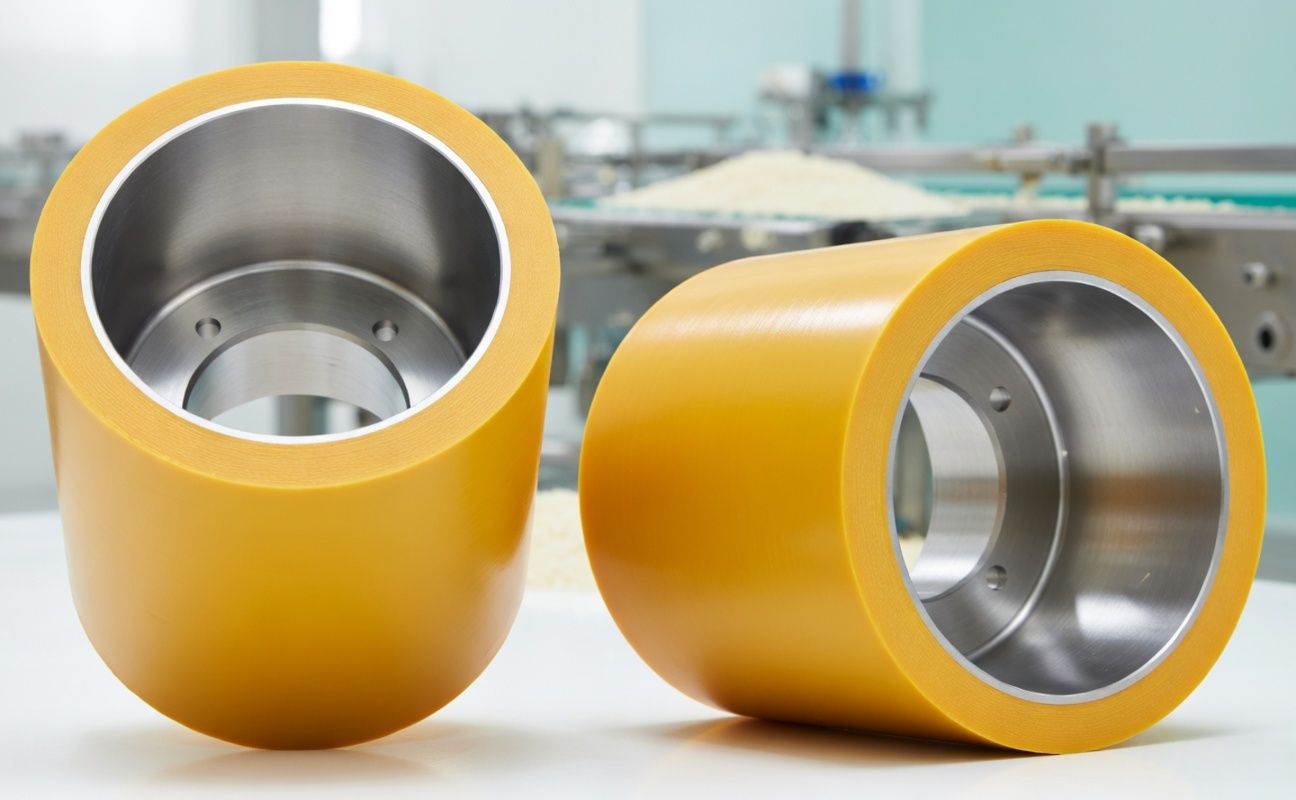
For Maximum Output & Minimum Broken rice.
Focused mainly on less broken rice for Basmati.
At Toughtec, we manufacture high-performance Rice De-husking Rubber Rolls designed to deliver maximum efficiency, durability, and consistency in rice milling operations. Built with advanced technology and premium raw materials, our rolls ensure precise de-husking, minimal grain breakage, and longer operational life.
Our advanced production capabilities also allow us to deliver customized hardness for each application — ensuring maximum yield and minimum grain breakage during the dehusking process.
With a commitment to helping rice millers worldwide achieve higher profits, we proudly present TOUGHTEC Rubber Roll for extreme efficiency and care for every grain which goes through milling process.
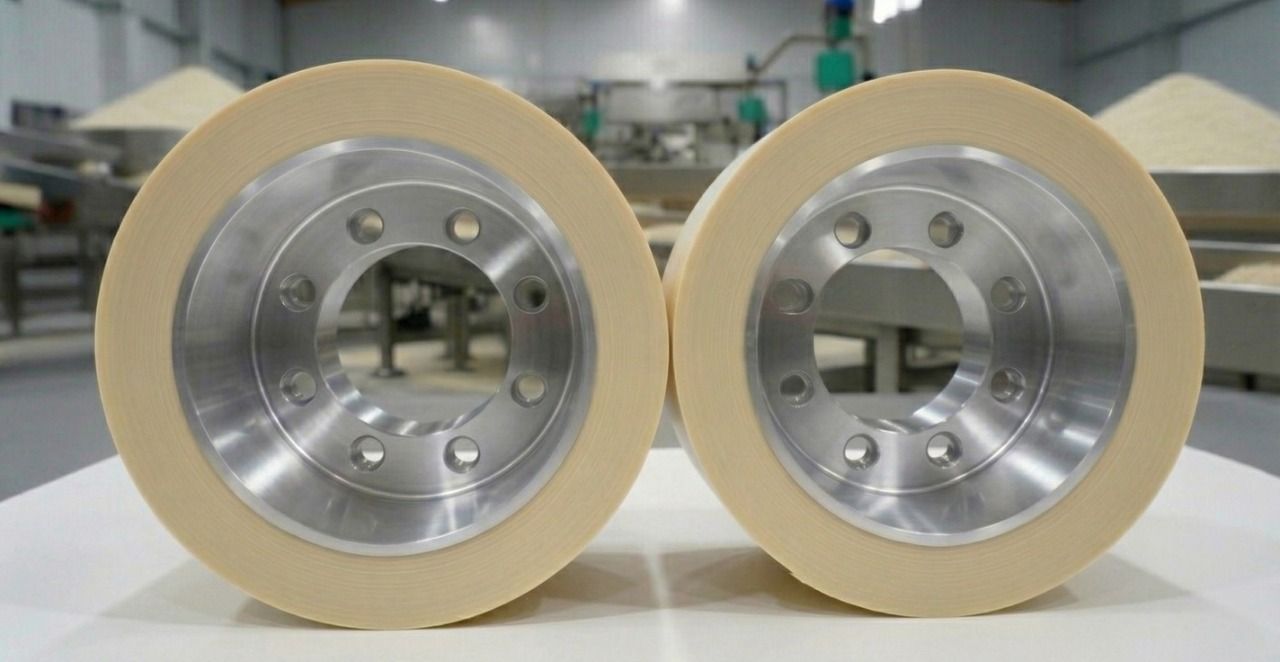
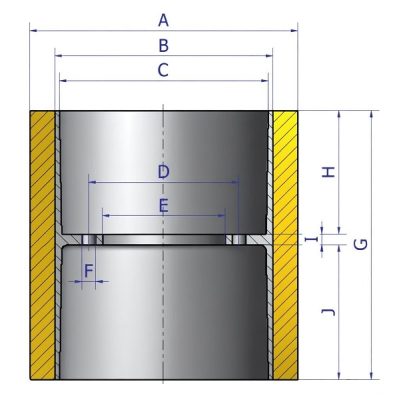
| TYPE | A | B | C | D | E | F | G | H | I | J |
|---|---|---|---|---|---|---|---|---|---|---|
| DMR 10" ALU | 254 ± 1.0 | 204 | 195 | 142 ± 0.30 | 116 ± 0.2 | 8-13mm | 254 ± 0.30 | 119 | 8 ± 0.30 | 127 ± 0.30 |
| 10" Jumbo ALU | 254 ± 1.0 | 193 | 184 | 142 ± 0.30 | 116 ± 0.2 | 13mm | 254 ± 0.30 | 119 | 8 ± 0.30 | 127 ± 0.30 |
| DMR 12" (4 Hole) | 254 ± 1.0 | 203 | 194 | 142 ± 0.30 | 116 ± 0.2 | 4-13mm | 304.8 | 141.4 | 10.5 | 152.4 |
| DMR 12" N5 (8 Hole) | 270 ± 1.0 | 205 | 196 | 150/156 ± 0.3 | 122 ± 0.1 | 13-18mm | 300 ± 0.30 | 140 | 10 ± 0.30 | 150 ± 0.30 |
A practical troubleshooting reference for pneumatic huskers, covering common rubber roll issues, likely operating causes, and the exact corrective actions recommended for smoother de-husking performance, proper roll usage, and longer service life.
Cracks on the rubber roll surface can happen for several reasons. One reason is that paddy does not fall in between the two rubber rolls and instead falls directly on the rubber rolls. Another reason is that the rubber rolls are not interchanged for long hours, due to which the roll on the faster shaft becomes very thin. Cracks may also occur if the rubber rolls are overheated because of an improper cooling system. High air pressure on the rolls may also cause overheating of the rolls. Another reason is that the rubber roll is not disengaged even when paddy does not flow. High moisture in paddy may also cause this problem.
If paddy is not falling in between the two rubber rolls and is falling directly on the rolls, the chute should be adjusted so that paddy falls in between the rolls. If the rolls are not being interchanged for long hours, then the rolls should be interchanged periodically so that the fast shaft always has the rubber roll with more rubber on it. If overheating is caused by improper cooling, then the cooling and exhaust blower arrangement should be checked. If high air pressure is causing overheating, then the pressure knob should be adjusted to maintain the recommended pressure. If the rubber roll is not disengaged even when paddy does not flow, then the pneumatic system should be checked and rectified. If the issue is related to high moisture in paddy, then moisture should be maintained at 14% at the time of de-husking.
Air burst or air bubble in a rubber roll can occur when high air pressure is applied on the rubber roll in the beginning when the new rolls are fitted. It can also happen because of shaft misalignment. Misalignment of the shaft may create very high pressure at some point, which can lead to the air burst problem.
When new rolls are fitted, the machine should be started with zero pressure, and the pressure should be slowly increased up to the optimum level within half an hour. In addition, shaft misalignment should be checked. If required, the shaft or bearing should be changed.
Circumferential lining on rubber appears when the paddy flow is not uniform.
It should be ensured that the vibrator plate or feeder is working properly. Any foreign material such as thread, grass, etc. should be removed from the shutter of the paddy flow. It should be checked periodically that the paddy falls uniformly in between the rubber rolls. The chute should also be checked for wear, and if it is worn out, it should be replaced with a new one.
Rubber to metal bonding failure is stated in the guide as a manufacturing defect. The guide also visually shows this issue with example product photographs on page 4.
The defective rubber roll should be removed immediately from the husker, and a new rubber roll should be fitted. The guide further states that in case of bonding failure, free replacement of the rubber roll is given.
An uneven surface impression pattern is made on the roll surface due to vibration in the roll. This vibration can be due to several reasons, including the bearing of the main shaft being worn out, improper V-belt tension, hinge shaft bearing or shaft being worn out, or the CI adaptor or coupling for the rubber roll being worn out.
If the bearing of the main shaft is worn out, it should be replaced with a new bearing. The V-belt tension should be checked and corrected. The hinge shaft and bearing assembly should be checked, and if required, repaired. If the adaptor or coupling is worn out, it should be changed.
Oxidization of the aluminum drum happens because the aluminum drum gets oxidized due to contact with moisture. The guide also shows an example image of an oxidized aluminum drum on page 6.
The rubber rolls should be stored away from moisture and any source of water. They should not be stored on the floor. They should always be stored on wooden, metallic, or plastic pallets. The packing should be removed only prior to use.
WhatsApp us